What Is Answer Engine Optimization (AEO)? The 2026 Guide to Ranking in ChatGPT, Perplexity & Google AI Overviews
 ·
· 
What Is Answer Engine Optimization (AEO)? The 2026 Guide to Ranking in ChatGPT, Perplexity & Google AI Overviews
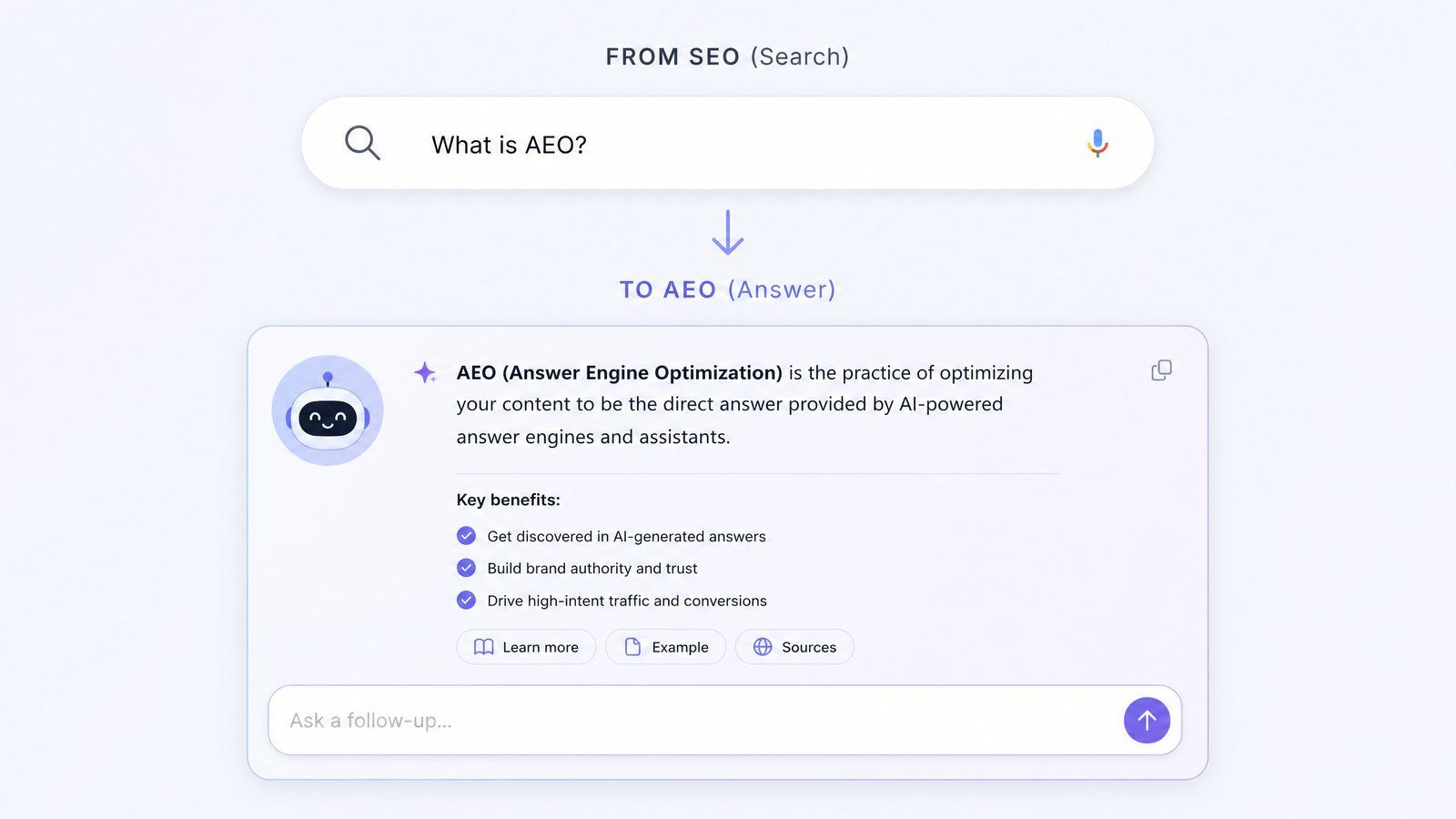
Quick answer: Answer Engine Optimization (AEO) is the practice of structuring your content so AI answer engines — ChatGPT, Perplexity, Google AI Overviews, and Gemini — quote and cite you when they answer a user’s question. Unlike SEO, which fights for a blue-link ranking, AEO competes to be the source the AI reads aloud. You win it by leading with direct answers, using question-shaped headings, adding structured data, and proving expertise.
If you’ve noticed your Google traffic sliding while more people get answers straight from ChatGPT, you’re seeing the single biggest shift in search since mobile. This guide explains what AEO is, how it differs from SEO, and the exact framework to start getting cited — in 2026, with no guesswork.
Written by Tobby (Astro Tobby) — I run a fully automated AI content pipeline and test these tactics on live sites every week.
What does AEO actually mean?
AEO (Answer Engine Optimization) is optimizing content to be selected, quoted, and cited by AI answer engines instead of just ranked in a list of links. When someone asks ChatGPT “what’s the best way to automate a blog,” the model pulls a few trusted sources and synthesizes an answer. AEO is the work that makes your page one of those sources.
The “answer engine” is any tool that returns a synthesized answer rather than ten links: ChatGPT search, Perplexity, Google AI Overviews, Gemini, and Bing Copilot.
How is AEO different from SEO?
They overlap, but the target is different. SEO wants a ranking position; AEO wants a citation inside the answer.
| SEO (traditional) | AEO (answer engines) | |
|---|---|---|
| Goal | Rank #1–10 in blue links | Get quoted/cited in the AI answer |
| Unit that wins | The whole page | A specific passage on the page |
| Reader sees | A list of links | One synthesized answer + citations |
| Wins with | Backlinks, keywords, authority | Direct answers, structure, entities, trust |
| Measured by | Rankings, organic clicks | Citations, brand mentions, referral from AI |
The good news: AEO and SEO are not enemies. A well-optimized AEO page usually still ranks well in classic search — you’re just also eligible to be the cited source.
Why does AEO matter in 2026?
Because the click is disappearing. More searches now end inside an AI answer with no visit to a website. If you only optimize for blue links, you become invisible the moment the user gets their answer from the model. AEO is how you stay in the conversation — literally, the AI says your name.
For anyone selling products, services, or content, being the cited source is the new “page one.” It builds authority and sends high-intent visitors who already trust you because the AI vouched for you.
How do AI answer engines choose who to cite?
Based on testing across ChatGPT, Perplexity, and Google AI Overviews, citations consistently favor pages that:
- Answer the exact question fast — within the first one or two sentences of a section.
- Are structured into clean, self-contained chunks the model can lift without rewriting.
- Use specifics — named tools, numbers, dates, versions — instead of vague claims.
- Carry trust signals — clear author, expertise, and original insight.
- Have machine-readable structure — FAQ schema, headings, tables, lists.
- Are fresh — recently published or updated.
How to do AEO: a 7-step framework
Here is the repeatable framework. Follow it on every page you want cited.
- Pick one real question. Target the exact phrasing people ask (e.g. “how do I rank in ChatGPT?”), not a keyword fragment.
- Lead with the answer. Open the page — and every section — with a 1–2 sentence direct answer the AI can quote verbatim.
- Use question-shaped headings. Make your H2s the literal questions people ask.
- Write extractable chunks. Each section should stand alone and make sense out of context.
- Add structure AI loves. Include at least one comparison table, one numbered list, and an FAQ section.
- Prove expertise. Add an author byline, first-hand experience, and specific data. AI engines weight credible sources.
- Mark it up. Add FAQ schema and Article schema so engines can parse your answers cleanly.
Do this consistently and you stop chasing algorithm updates — you become the source the algorithms quote.
Can you automate AEO content?
Yes — and you should. The framework above is a template, which means it can be produced at scale with an AI content pipeline that bakes the AEO structure into every post automatically. That’s exactly how this blog is run: each article is generated, AEO-structured, published, and turned into video without manual work.
Frequently asked questions
Is AEO replacing SEO? No. AEO sits on top of SEO. Solid technical SEO still helps you get discovered and crawled; AEO determines whether you get cited once you’re found.
How long does AEO take to work? Faster than classic SEO in many cases — AI engines surface fresh, well-structured answers quickly. Expect early citations in weeks, not months, if your structure and authority are right.
Do I need backlinks for AEO? They help with overall authority, but clear structure, direct answers, and topical depth matter more for getting quoted than raw backlink count.
What’s the fastest way to start? Audit one existing page against the 7-step framework, rewrite the opening of each section to lead with a direct answer, and add an FAQ block with schema.
Get the full system
This guide covers the what and why. If you want the complete, step-by-step playbook — the exact prompts, schema templates, and a citation-tracking method — that’s what these are built for:
- AEO Masterguide 2026 — Rank in AI Search → ($9.80) — the full framework, prompts, and templates.
- AEO Audit & Optimization Toolkit → ($10.50) — a done-for-you checklist to audit and fix any page for AI citations.