Beyond SEO: Why Answer Engine Optimization (AEO) Is the Future of Search in 2026
 ·
· 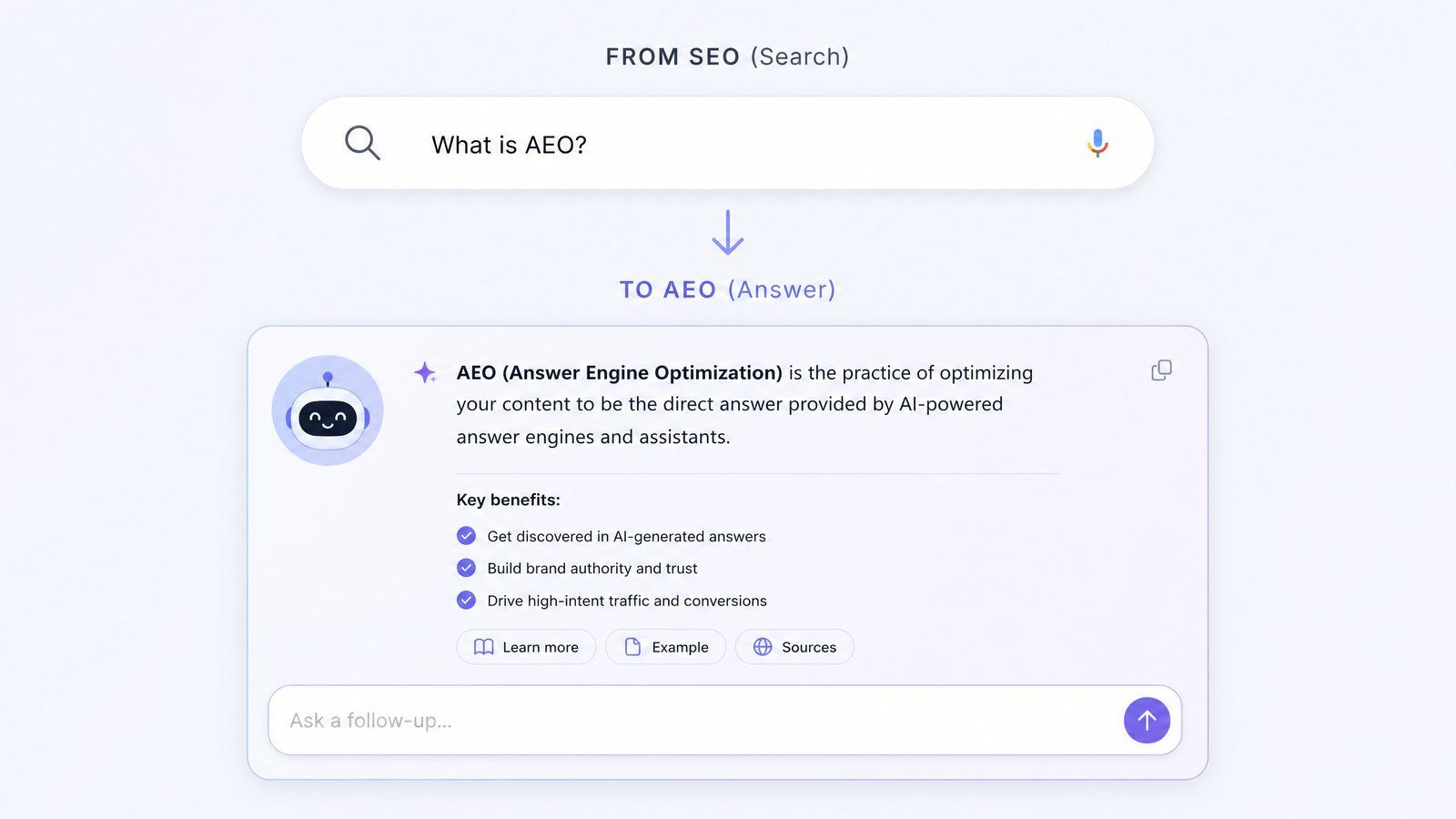
In the rapidly evolving landscape of artificial intelligence, the way we search for and consume information is undergoing a profound transformation. While Search Engine Optimization (SEO) has long been the cornerstone of digital visibility, a new paradigm is emerging: Answer Engine Optimization (AEO). In 2026, AEO isn't just a buzzword; it's becoming the critical differentiator for businesses and content creators aiming to thrive in an AI-first world.
The Shift from Links to Answers: What is AEO?
For years, SEO focused on ranking web pages in search results, primarily by optimizing for keywords, backlinks, and technical performance. The goal was to get users to click on a link and navigate to your site. However, with the proliferation of advanced AI models and large language models (LLMs), users are increasingly getting direct, synthesized answers to their queries without ever leaving the search interface or interacting with a traditional webpage. This is the essence of AEO.
Answer Engine Optimization (AEO) is the strategic process of structuring and optimizing your content so that AI-powered answer engines and LLMs can easily understand, extract, and present it as a direct, authoritative answer to a user's question [3]. It's about being the source that AI trusts and cites.
Why 2026 is the Year of AEO
The shift towards AEO has been building, but 2026 marks a pivotal year due to several key developments:
•Sophisticated LLMs: AI models like GPT-5 and Claude Mythos are more adept than ever at comprehending complex queries and synthesizing information from vast datasets. They don't just find keywords; they understand context and intent.
•Zero-Click Searches: A growing percentage of searches result in "zero-click" outcomes, where users find their answer directly on the search results page or through an AI assistant, negating the need to click through to a website [9].
•Voice Search and AI Assistants: The rise of voice-activated assistants and AI-powered chatbots means users are asking questions conversationally, expecting concise, accurate answers rather than a list of links.
•E-E-A-T (Experience, Expertise, Authoritativeness, Trustworthiness): Google's emphasis on E-E-A-T has become even more crucial for AI. Content that demonstrates genuine expertise and trustworthiness is more likely to be selected by AI as a reliable source [4].
AEO vs. SEO: A Symbiotic Relationship
It's important to understand that AEO doesn't replace SEO; it complements and elevates it. Think of it this way: SEO gets your content discovered by search engines, while AEO ensures your content is chosen by answer engines. A robust SEO strategy provides the foundation, making your content crawlable and discoverable. AEO then refines that content for direct answerability.
Feature | SEO (Traditional Focus) | AEO (Emerging Focus) |
Primary Goal | Drive traffic to website via clicks | Provide direct, authoritative answers to user queries |
Key Metrics | Organic traffic, keyword rankings, bounce rate | AI citation rate, featured snippets, direct answer visibility |
Content Style | Broad, keyword-rich, link-focused | Concise, question-answering, fact-based, structured |
Optimization | Keywords, backlinks, technical SEO, site speed | Structured data, clear Q&A, E-E-A-T, semantic clarity |
How to Optimize for the Answer Engine
To position your content for AEO success in 2026, consider these strategies:
1.Understand User Intent and Question Demand: Go beyond keywords. What are the actual questions your audience is asking? Tools that analyze conversational search queries can be invaluable [4].
2.Optimize for Direct Answers: Structure your content to directly answer common questions. Use clear headings, bullet points, numbered lists, and concise paragraphs. Think of your content as a potential "featured snippet" or a direct response from an AI assistant.
3.Implement Advanced Schema Markup: Use structured data (Schema.org) to explicitly tell AI what your content is about. This helps AI understand the context and relationships within your data, making it easier to extract answers [4].
4.Prioritize E-E-A-T: Build genuine authority and trust. Ensure your content is accurate, well-researched, and written by credible experts. Include author bios and citations to strengthen your E-E-A-T signals.
5.Create Comprehensive, Yet Concise Content: While AI values comprehensive information, it also prioritizes conciseness for direct answers. Provide thorough explanations, but ensure key answers are easily digestible.
6.Focus on Semantic Clarity: AI understands concepts and relationships. Write naturally, using related terms and phrases that demonstrate a deep understanding of the topic, rather than just keyword stuffing.
The Future is Conversational and Direct
As AI continues to integrate into every aspect of our digital lives, the way we interact with information will become increasingly conversational and direct. AEO is not just a fleeting trend; it's a fundamental shift in how we create and optimize content for the intelligent web. By embracing AEO now, you're not just adapting to the future; you're shaping it.

References
This post may contain affiliate links. We may earn a commission at no extra cost to you.