The Death of Prompting: Why Agentic AI is Leaving Traditional...
 ·
· 
The End of an Era: Why Prompt Engineering is Becoming Obsolete
For years, the art of crafting the perfect prompt was considered the pinnacle of AI interaction. Prompt engineers meticulously designed intricate instructions, personas, and few-shot examples to coax optimal responses from large language models (LLMs). This skill was highly sought after, even dubbed the “hottest AI job of 2023” [3]. However, as we move deeper into 2026, the landscape has shifted dramatically, and reports of the “death of prompt engineering” are not just sensationalism; they reflect a fundamental evolution in how we interact with artificial intelligence [1] [2].
The primary reason for this paradigm shift lies in the rapid advancement of AI models themselves. Modern frontier models have become remarkably adept at inferring intent, understanding nuanced instructions, and generating genuinely useful responses with minimal hand-holding [1]. The marginal gains from painstakingly engineering a prompt have significantly diminished. What once required elaborate XML schemas or “think step by step” directives, models now achieve through improved instruction-following, larger context windows, and billions of examples of human intent baked into their training [1]. As Microsoft CMO of AI at Work Jared Spataro noted, “Two years ago, everybody said, ‘Oh, I think Prompt Engineer is going to be the hot job… [but] you don’t have to have the perfect prompt anymore” [1].
Beyond smarter base models, the fragility and lack of scalability inherent in traditional prompt engineering have exposed its limitations. Minor changes in input, model versions, or even random model drift can undermine prompt effectiveness. Furthermore, every new feature or edge case demands more prompt variations and manual maintenance, making it an unsustainable foundation for serious, production-grade AI systems [2].
The Rise of Agentic AI: The Future is Autonomous Workflows
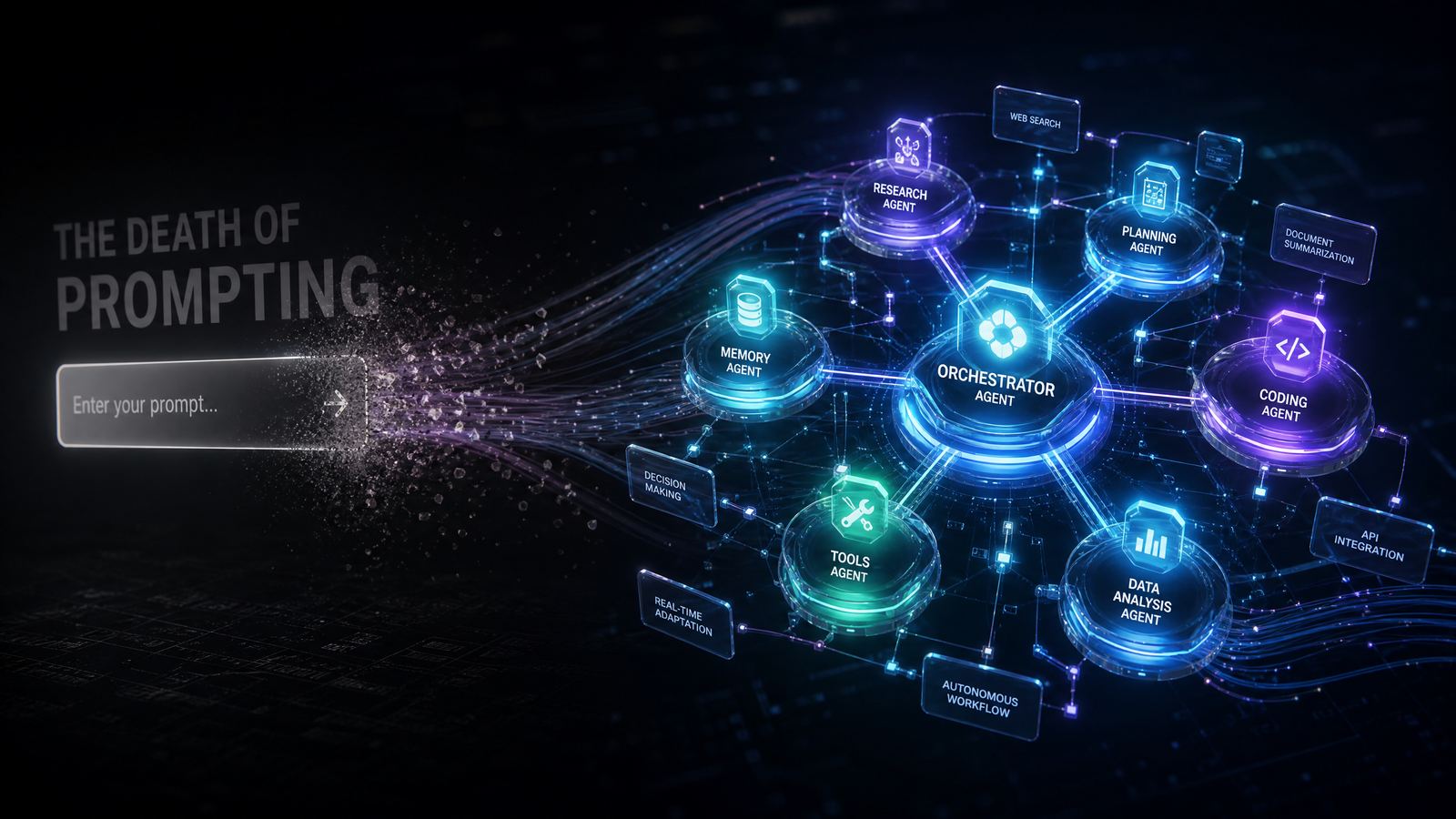
The more profound shift, however, is the rapid transition from simple prompt-in, response-out interactions to agentic AI systems. Agentic AI refers to AI systems that can autonomously pursue goals, make decisions, use tools, and take multi-step actions with minimal human supervision [1] [4]. In this new paradigm, the “prompt” is almost beside the point; what truly matters is the system architecture, the tools an agent has access to, and how it manages memory, context, and decision-making across multiple steps [1].
This evolution introduces concepts like Flow Engineering and Context Engineering as the new critical skills. Flow engineering is the practice of designing multi-step, iterative workflows for AI systems instead of relying on single-shot prompts [3]. It allows AI to break down complex problems, generate initial attempts, critique its own work, run tests, and revise based on feedback, much like a human would approach a complex task [3]. Andrew Ng’s research demonstrated that a weaker, cheaper model wrapped in an “agentic workflow” could nearly double the performance of a more advanced model using a single prompt, highlighting that “the improvement from GPT-3.5 to GPT-4 is dwarfed by incorporating an iterative agent workflow” [3].
Context Engineering, a term popularized by Andrej Karpathy, emphasizes the “delicate art and science of filling the context window with just the right information for the next step” [3]. It involves dynamically assembling and delivering background information, system instructions, retrieved documents, and conversation history to the model at each stage of a workflow. This ensures the AI has precisely the context required for each decision, reducing ambiguity and minimizing hallucination risks [2] [3].
Key Patterns of Agentic Workflows
Agentic AI systems leverage several core design patterns to achieve their autonomous capabilities [3]:
- Reflection: The AI critiques its own output and iterates to improve, often involving a generative agent and a critical agent debating to refine outcomes.
- Tool Use: Agents can call external tools such as web search, code execution, APIs, and databases, enabling them to retrieve real-world information and take actions.
- Planning: Agents break down complex tasks into a sequence of smaller steps and execute them systematically, adjusting their approach if a step fails.
- Multi-Agent Collaboration: Multiple specialized AI agents work together, each handling different parts of a complex task, communicating and iterating to achieve a common goal.
Don’t Get Left Behind: The Imperative for Adoption
The shift to agentic AI is not merely a technological upgrade; it’s a strategic imperative for businesses and individuals alike. Those who cling to outdated prompting methodologies risk being outmaneuvered by competitors who embrace autonomous workflows. The skills that made someone valuable in 2023 are rapidly becoming table stakes or, worse, obsolete [3].
| Feature | Traditional Prompt Engineering | Agentic AI & Workflow Architecture |
|---|---|---|
| Interaction Model | Single prompt-in, response-out | Multi-step, iterative workflows with autonomous actions |
| Scalability | Limited; fragile to changes, manual maintenance | High; automated context generation, adaptable workflows |
| Complexity | Relies on intricate prompt crafting | Manages complexity through system architecture, planning, and tools |
| Key Skill | Crafting perfect prompts | Designing systems, evaluating outcomes, workflow architecture |
| Efficiency | Often requires extensive human iteration on prompts | Automates tasks, augments human capabilities, increases productivity |
| Business Value | Task-specific outputs, often requiring human integration | End-to-end solutions, new business models, strategic advantage |
This new era demands a focus on AI systems evaluation as the most critical discipline [1]. As AI systems become more complex, with agents taking dozens of actions across multiple tools and memory layers, eyeballing outputs is no longer sufficient. Systematic methods for measuring accuracy, consistency, and adherence to guardrails are paramount [1]. Tools like Langfuse are emerging to provide observability and evaluation infrastructure, allowing teams to track traces, define scoring functions, and monitor performance over time [1].
For organizations, this means asking critical questions: How will your systems generate, update, and deliver context at scale without constant developer intervention? Who owns the specification for each step’s input and output? Are your tools designed to emit machine-readable summaries and input contracts? [2]
Conclusion: The Agentic Future is Now
The integration of AI agents into sophisticated, automated workflows is not a distant future; it is the present reality of 2026. Businesses and individuals who embrace this paradigm shift will be best positioned to unlock unprecedented levels of productivity, foster innovation, and create sustainable competitive advantages. The key lies in understanding not just what AI agents can do, but how they can be strategically woven into the fabric of daily operations to deliver real, measurable business value. Don’t be left behind; the revolution is already underway.
References
- The Death of Prompt Engineering, And How Evals Are Rising in Its Place
- Prompt Engineering Is Dead, and Context Engineering Is Already Obsolete: Why the Future Is Automated Workflow Architecture with LLMs
- AI Prompt Engineering Is Dead. Here’s Why.
- The Complete Guide to Agentic SEO: How AI Agents Transform Search Optimization
This post may contain affiliate links. We may earn a commission at no extra cost to you.