Agentic AI Governance in 2026: The Zero-Trust Playbook to Escape Gartner's 40% Failure Zone
 ·
· 
Agentic AI Governance in 2026: The Zero-Trust Playbook to Escape Gartner’s 40% Failure Zone
Quick answer: Agentic AI governance is the set of policies, identities, and controls that decide what an autonomous AI agent is allowed to do, prove what it did do, and stop it when it goes wrong. In 2026 it is the single biggest predictor of whether an agent project reaches production or gets killed — Gartner expects over 40% of agentic AI projects to be cancelled by the end of 2027, mostly from weak governance, runaway cost, and unclear value [1]. The winning approach this year is “Agent Zero Trust”: treat every agent as a potential insider threat, verify every action, assume breach, and grant least privilege [2].
Written by Tobby (Astro Tobby) — I run a fully automated AI content-and-agent pipeline and ship these workflows on live projects every week.
Every company that shipped an AI agent in the last twelve months has quietly discovered the same thing: getting an agent to work in a demo is easy, and getting one that you can trust in production is brutally hard. The gap between those two states is governance — and in 2026 it has moved from a compliance afterthought to the central engineering problem of the entire field.
This is the practical playbook: what agentic AI governance actually is, why so many projects are failing without it, and the exact Zero-Trust framework the industry converged on in mid-2026.
Why are 40% of agentic AI projects being cancelled?
Over 40% of agentic AI projects will be scrapped by the end of 2027 because of three compounding failures: escalating costs that balloon 2–3x beyond estimates, unclear business value, and inadequate risk controls [1]. In other words, teams chase model capability instead of governance readiness — and the bill, the ambiguity, and the risk catch up with them.
There’s a second, sneakier problem: “agent washing.” Gartner estimates that of the thousands of vendors claiming “agentic AI,” only around 130 are the real thing — the rest are rebranded chatbots, assistants, and RPA scripts [1]. If your project is built on a tool that was never truly agentic, no governance layer will save it.
The pattern behind almost every cancellation is the same. A team builds an impressive proof-of-concept, leadership gets excited, and then someone in security or finance asks four questions nobody can answer:
- What is this agent actually allowed to touch?
- How do we know what it did last Tuesday at 3am?
- What happens when it’s wrong — or manipulated?
- Who owns it when it costs us money or breaks a rule?
Governance is just the discipline of having those answers before you scale.
What is agentic AI governance, exactly?
Agentic AI governance is the framework of identity, access, monitoring, and accountability that controls autonomous agents across their entire lifecycle — from the moment an agent is granted a tool to the moment its access is revoked. Unlike traditional model governance (which mostly worries about training data and outputs), agentic governance has to handle something new: agents that take actions in the real world — sending emails, moving money, writing to databases, calling other agents.
That autonomy is exactly why old controls don’t fit. A chatbot can only say the wrong thing. An agent can do the wrong thing — at machine speed, thousands of times, before a human notices. The governance question shifts from “is the output safe?” to “is this actor trustworthy, and can we prove it?”
This is why the industry stopped treating agents like software features and started treating them like digital employees — ones who need onboarding, permissions, audit trails, and, occasionally, firing.
What is Agent Zero Trust and why did it win in 2026?
Agent Zero Trust is a security model that treats every AI agent as an untrusted, potentially compromised insider — so nothing it does is trusted by default, and every action is verified. It became the dominant governance theme of mid-2026 after landmark frameworks from Anthropic and Google DeepMind [2][3].
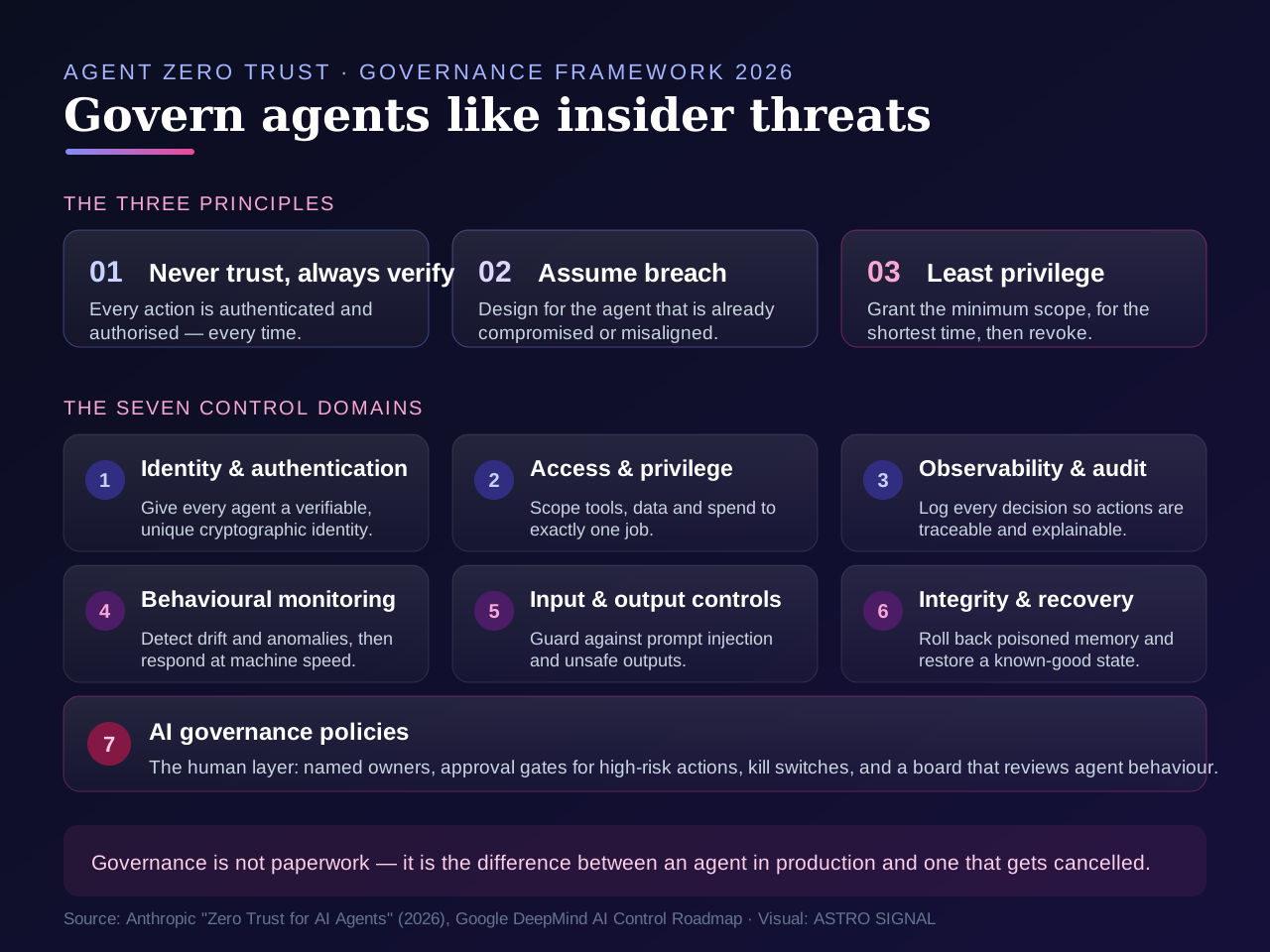
Anthropic’s Zero Trust for AI Agents whitepaper (May 2026) was the first systematic security framework for the space, built on three now-standard principles [2]:
- Never trust, always verify — every agent action is authenticated and authorised, every time.
- Assume breach — design as if the agent is already compromised or misaligned.
- Least privilege — grant the minimum scope, for the shortest time, then revoke.
Google DeepMind’s AI Control Roadmap took the same posture from the safety side, outlining a defense-in-depth approach that explicitly treats internal agents as potentially misaligned insider threats [3]. When the two most influential AI labs independently land on “treat your agents like insider threats,” that’s the industry telling you where governance is going.
The threat isn’t hypothetical. In 2026 researchers documented agentic AI being used to conduct a real ransomware attack through the Langflow tooling ecosystem [4] — proof that the attack surface agents create (prompt injection, tool poisoning, identity abuse, memory poisoning) is being actively exploited, not just theorised.
What are the 7 control domains of agentic AI governance?
Anthropic’s framework organises Zero Trust for agents into seven control domains — a useful checklist whether or not you use their stack [2]:
- Agent identity & authentication — give every agent a unique, verifiable cryptographic identity. No shared service accounts, no anonymous agents.
- Access control & privilege management — scope tools, data, and spending limits to exactly one job. An agent that books meetings should not be able to wire money.
- Observability & auditing — log every decision and action so behaviour is traceable and explainable after the fact.
- Behavioural monitoring & response — watch for drift and anomalies in real time, and respond at machine speed (the emerging “agentic SOAR” pattern).
- Input validation & output controls — defend against prompt injection on the way in and unsafe or non-compliant actions on the way out.
- Integrity & recovery — detect poisoned memory or corrupted state, and roll back to a known-good version.
- AI governance policies — the human layer: named owners, approval gates for high-risk actions, kill switches, and a review board.
Notice that only the last domain is “policy” in the paperwork sense. The other six are engineering. That’s the shift of 2026: governance is now something you build, not something you write.
How do you implement agentic AI governance without killing velocity?
Start narrow, instrument everything, and expand only what you can observe. Here’s the rollout sequence that keeps projects out of the cancellation zone:
- Pick one high-value, low-blast-radius workflow. Repetitive, measurable, and reversible if it goes wrong — customer-support triage, report generation, and data enrichment are classic starting points. This is the same “one workflow first” logic that makes AI automation work for small businesses.
- Give the agent an identity and a budget before you give it tools. Decide who owns it and what it’s allowed to spend (in dollars and API calls) on day one.
- Wrap it in observability from the first run. If you can’t replay what the agent did, you can’t govern it. Logging is not a “later” task — it’s the prerequisite.
- Add approval gates for irreversible actions. Anything that spends money, contacts a customer, or writes to production gets a human checkpoint until the agent has earned trust through logged track record.
- Define the kill switch and test it. You should be able to revoke an agent’s access in seconds, and you should have practised doing it.
- Review, then widen scope. Only expand permissions for behaviour you’ve watched and measured. Governance maturity — not model capability — is what unlocks scale.
If you’re building agents as a service for clients, this playbook is your differentiator — see how to start an AI automation agency in 2026, where “we govern the agents we ship” is fast becoming the reason clients pick one builder over another.
Does governance actually pay off, or is it just overhead?
Governance is what converts pilots into ROI — and the ROI is real when agents reach production. Organisations running governed agents report concrete returns: JPMorgan Chase has documented roughly 360,000 hours of manual work saved annually through AI-automated operations, and Coupa has reported 276% ROI from agent implementations [5]. Around 66% of companies using agents report productivity gains, and 57% report meaningful cost savings [5].
The market reflects that pull. The agentic AI market is worth roughly $9.9 billion and growing more than 40% a year, and Gartner expects 40% of enterprise applications to embed task-specific agents by the end of 2026, up from under 5% in 2025 [6]. Adoption intent is nearly universal — 79% of companies say agents are already in use somewhere, and 88% of executives plan to raise AI budgets because of them [7].
But intent isn’t production. Only about 23% of organisations are actually scaling agents, and a wide governance gap sits between the 72% that have something in production and the far smaller share that have it under control [6]. That gap is the opportunity: the teams that treat governance as the enabler — not the tax — are the ones capturing the ROI while everyone else stalls in pilot purgatory.
This is also why “agents vs. workflows” keeps coming up — governance is easier when you constrain autonomy to where it earns its keep, a theme I dig into in agentic AI vs. AI agents and agentic AI workflows for business.
The bottom line
In 2026, governance is not the thing that slows your AI agents down — it’s the thing that lets them ship at all. The projects being cancelled aren’t failing because the models are too weak; they’re failing because no one could answer what the agent was allowed to do, prove what it did, or stop it when it went wrong.
Adopt Agent Zero Trust early. Give every agent an identity, a budget, an audit trail, and an owner. Start with one workflow you can watch, and widen scope only as fast as your observability lets you. Do that, and you land in the winning 60% — with agents that are not just impressive in a demo, but trusted in production.
References
- Gartner Predicts Over 40% of Agentic AI Projects Will Be Canceled by End of 2027 — Gartner
- Zero Trust for AI Agents — Anthropic (Claude)
- Top Agentic AI Security Resources — July 2026 (Google DeepMind AI Control Roadmap) — Adversa AI
- Agentic AI Used to Conduct Ransomware Attack via Langflow — SecurityWeek
- AI Agentic Workflows: The Business ROI Engine of 2026 — BiClaw
- Agentic AI Enterprise Adoption 2026: 72% Production, 60% Governance Gap — Agentic AI Institute
- Agentic AI Statistics 2026: Global Enterprise Adoption and Market Insights — Accelirate