The End of Cheap AI: Why Your $20 Subscription is a Lie and the 'Rational Trap' of 2026 Layoffs
 ·
· 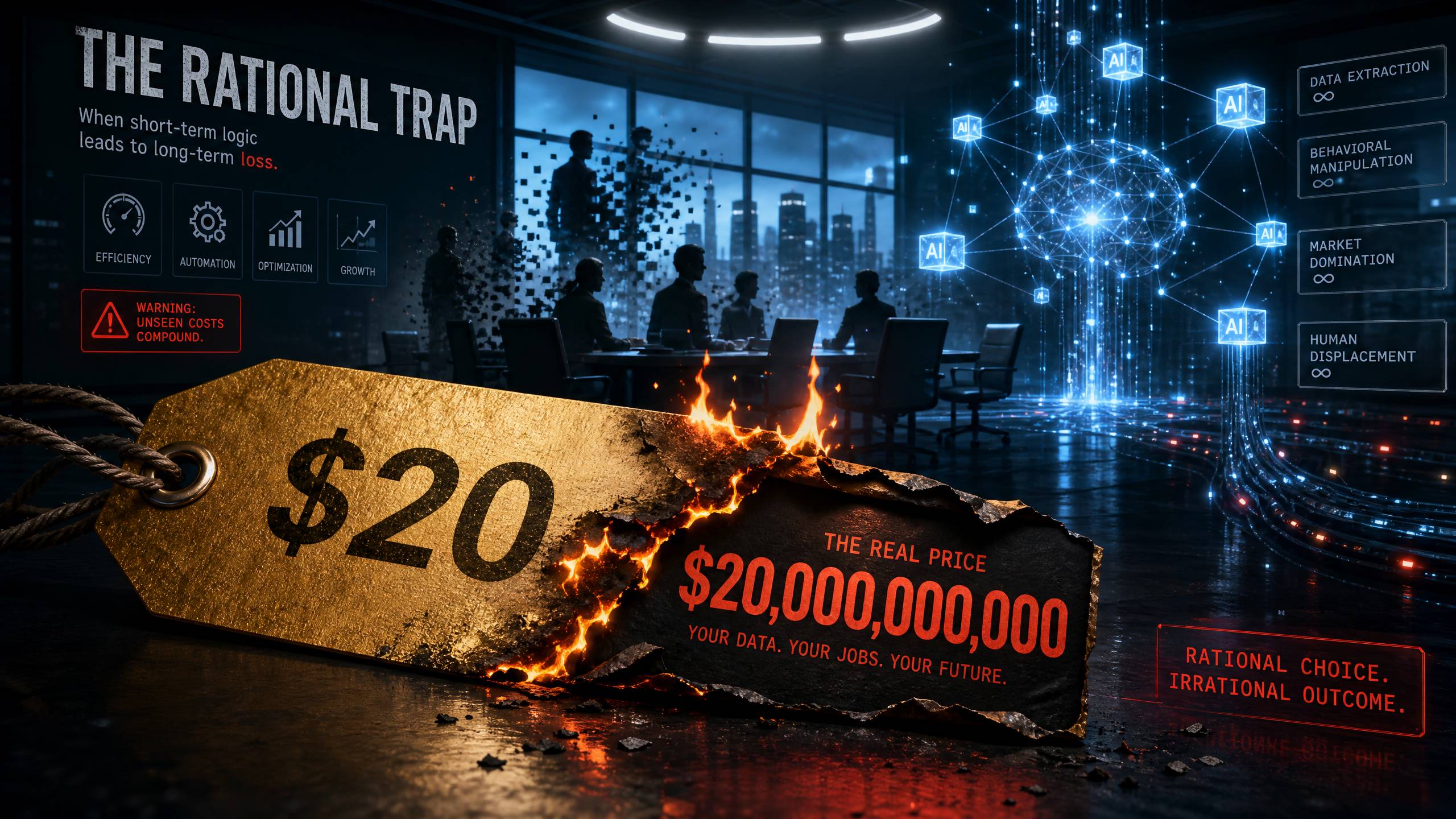
The End of Cheap AI: Why Your $20 Subscription is a Lie and the ‘Rational Trap’ of 2026 Layoffs
If you are currently paying $20 a month for ChatGPT Plus, Claude Pro, or a similar AI subscription, you are living in a heavily subsidized fantasy. The consumer pricing model that has defined the AI boom is not a reflection of actual costs; it is a market-building exercise funded by billions in venture capital. And in June 2026, the bill is finally coming due.
As the tech industry grapples with the staggering costs of running advanced large language models, a dual crisis is emerging. Not only are AI subscription prices poised to skyrocket, but the relentless drive for efficiency has triggered a wave of layoffs that experts are now calling the “Rational Trap.”
The Illusion of the $20 Subscription
The gap between what consumers pay and what AI providers spend to serve them is staggering. Running a large language model at scale requires massive GPU clusters, enormous energy consumption, and significant engineering overhead. OpenAI, for instance, has reported annual operating losses in the billions. This math only works if investors are continuously writing large checks.
However, the zero-interest-rate era that made decade-long loss-leading strategies viable is over. With OpenAI closing a $40 billion funding round in early 2025 and reaching a $300 billion valuation, the pressure from venture capital to show a credible path to profitability is intensifying. The acquisition phase is largely complete; hundreds of millions of people now use AI daily. What comes next is the monetization phase, and that inevitably means prices are going up.
Furthermore, inference costs are rising, not falling. As users increasingly rely on more capable “reasoning” models—which think through problems step-by-step before answering—the compute required per query can be 10 to 100 times higher than a standard response. The $20 price point was never meant to be permanent; it was a hook.
The “Rational Trap” of AI Layoffs
While consumers face an impending price shock, the workforce is already feeling the devastating impact of AI integration. In 2025, 100,000 tech workers were laid off, followed by another 92,000 in the first few months of 2026 alone. This is not merely a correction; it is a systemic crisis driven by what industry analysts term the “Rational Trap.”
Consider the perspective of a CEO. When presented with data showing that competitors who replaced parts of their engineering teams with AI tools cut costs by 30 to 40 percent and saw their share prices climb, the decision to reduce headcount becomes a rational, almost inevitable, business move. If a company cuts its engineering staff by 35 percent and its stock price jumps 22 percent the next morning, the market is actively rewarding the displacement of human labor.
Every company replacing workers with AI is making a rational decision for its own bottom line. However, when every company makes this rational decision simultaneously, it creates a systemic crisis. The workforce is hollowed out, consumer purchasing power diminishes, and the very economic foundation that supports these businesses begins to erode.
A Two-Track Labor Market
The integration of AI is creating a starkly divided labor market. While AI displaces specific tasks and entire job categories, it also augments human capabilities for those who can adapt. However, the transition is brutal. The growing wave of AI layoffs has left workers in a constant state of anxiety, wondering if their next performance review will come with a promotion or a pink slip.
The backlash is already brewing. The 2026 graduation season has seen commencement speakers and students alike voicing profound anxiety about a job market increasingly dominated by autonomous agents. The narrative that “AI won’t take your job, someone using AI will” is offering little comfort to the tens of thousands of skilled professionals who have already been replaced by efficient, cost-cutting algorithms.
Conclusion: The Reckoning
The tech industry is standing at a precipice. The heavily subsidized era of cheap AI is ending, and the true cost of these powerful tools is about to be passed on to the consumer. Simultaneously, the “Rational Trap” of AI-driven layoffs is reshaping the workforce in ways that prioritize short-term shareholder value over long-term economic stability.
As we navigate the second half of 2026, the conversation must shift from blind optimism about AI’s potential to a critical examination of its economic and social costs. The $20 subscription was a lie, and the efficiency gains of AI are coming at a steep price. The question now is whether society is prepared to pay it.