Vibe Coding The Intuitive Language Reshaping Deve
 ·
· 

Vibe Coding: The Intuitive Language Reshaping Development in 2026
In the rapidly evolving landscape of artificial intelligence, the very definition of "coding" is undergoing a profound transformation. For years, software development has been synonymous with meticulous syntax, complex frameworks, and lines upon lines of code. However, as we step into 2026, a new paradigm is emerging: Vibe Coding. This isn't merely an evolution of existing tools; it's a fundamental shift towards intent-based development, where the "vibe" or high-level architectural vision takes precedence over granular syntax.
Beyond the Copilot: Understanding the Vibe Shift
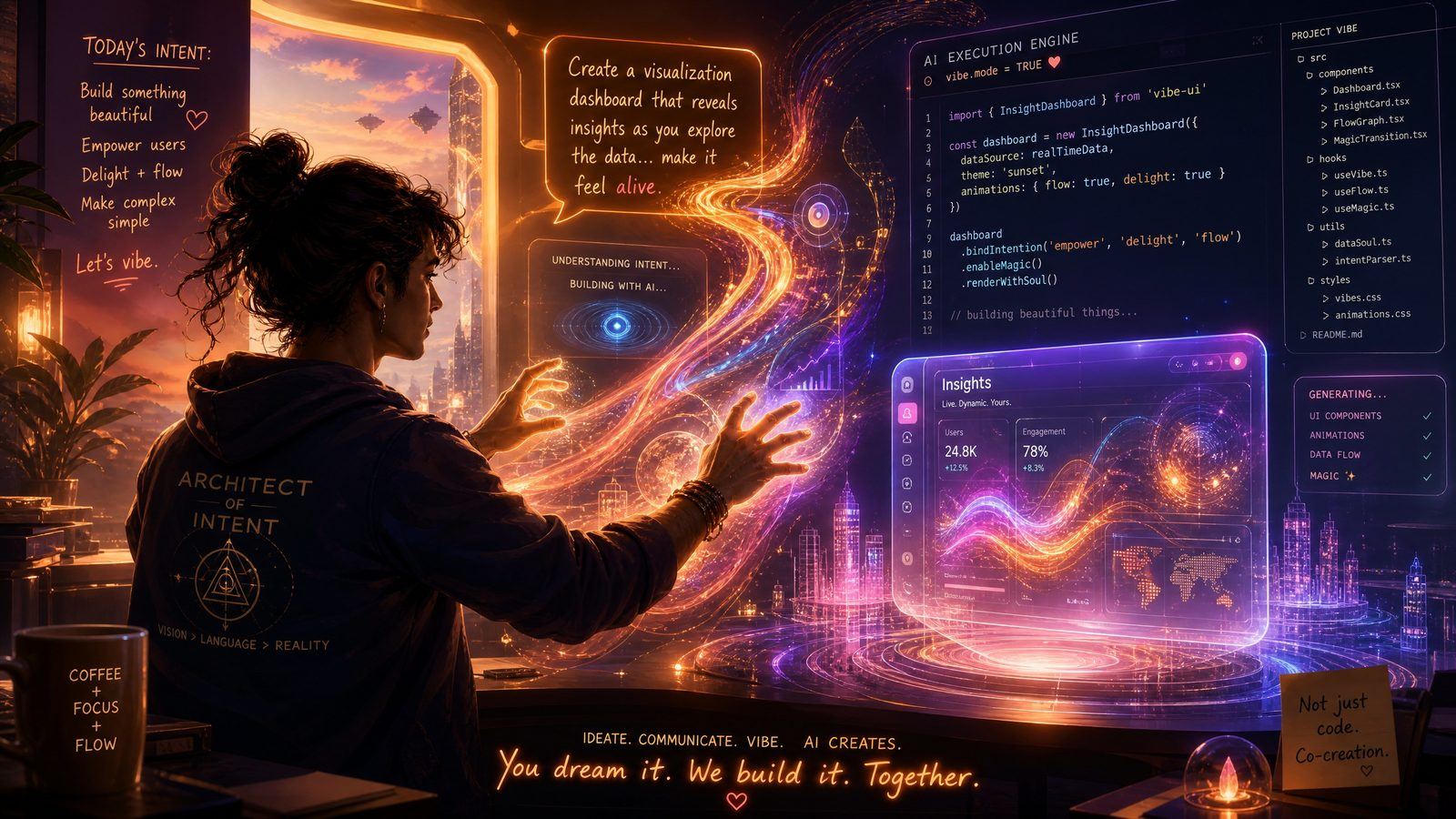
The AI-powered coding assistants of 2024 and 2025, often referred to as "copilots," were revolutionary in their ability to auto-complete code, suggest functions, and even generate small snippets based on comments. They augmented the developer's workflow, making it faster and more efficient. Vibe Coding, however, transcends this assistive role. It empowers users, even those without deep technical expertise, to articulate their desired outcome or system behavior in natural language, allowing advanced AI models to translate that "vibe" into functional applications.
Imagine describing the desired user experience, the data flow, and the core functionalities of an application, and having an AI construct the underlying architecture and code. This is the promise of Vibe Coding. It moves the focus from how to build to what to build, enabling a broader spectrum of innovators to bring their ideas to life without getting bogged down in the intricacies of programming languages.
The Rise of the AI Architect
This shift doesn't diminish the role of human expertise; rather, it redefines it. The traditional "coder" may evolve into an "AI Architect" or "Vibe Orchestrator." These professionals will be responsible for:
•Defining the Vision: Clearly articulating the project's purpose, user needs, and desired "vibe."
•Guiding the AI: Providing high-level instructions, refining AI-generated outputs, and ensuring alignment with strategic goals.
•Ethical Oversight: Ensuring that AI-generated solutions are fair, secure, and responsible.
•System Integration: Connecting AI-developed components with existing infrastructure and services.
This new role emphasizes conceptual thinking, problem-solving, and strategic design over rote memorization of syntax. It fosters a more creative and collaborative development environment, where humans and AI work in tandem to build sophisticated systems.
Impact on Innovation and Accessibility
Vibe Coding is poised to democratize software development, making it accessible to a wider audience. Non-technical founders, artists, and domain experts can now directly participate in the creation process, accelerating innovation across industries. The ability to rapidly prototype and iterate based on conceptual input will drastically reduce development cycles and costs.
However, this paradigm also introduces new challenges, particularly in ensuring the quality, security, and maintainability of AI-generated code. The "AI Architect" will play a crucial role in validating these outputs and establishing robust governance frameworks.
As 2026 unfolds, Vibe Coding is not just a trend; it's becoming the intuitive language of innovation, empowering a new generation of creators to shape our digital future
This post may contain affiliate links. We may earn a commission at no extra cost to you.